

A windshield chip can look minor, but the correct service depends on more than appearance. The damage’s size, depth, location, age, and effect on visibility all matter. In general, a small, shallow chip away from the driver’s primary viewing area may be a good candidate for resin repair. A long crack, edge damage, severe impact, or distorted view commonly points to windshield replacement.
Your windshield is also part of the vehicle’s occupant-protection system. Federal safety requirements address windshield glazing, retention, visibility, and occupant protection, and NHTSA has recognized that windshields can provide structural support during a rollover. ([nhtsa.gov](https://www.nhtsa.gov/document/final-rule-federal-motor-vehicle-safety-standards-roof-crush-resistance-phase-reporting-0?utm_source=openai)) Because an incorrect diagnosis or poor installation can create a safety risk, use this guide as a screening tool—not as a substitute for an inspection by a qualified auto-glass professional.
Windshield repair or replacement: the quick answer
Repair is often considered when the damage is small, limited primarily to the outer glass layer, not connected to the windshield edge, and outside the driver’s critical viewing area.
Replacement is more likely when the crack is lengthy or spreading, the damage reaches an edge, the glass is deeply penetrated, there is delamination between the layers, or the damage interferes with the driver’s vision.
There is no single measurement that guarantees a repair will be successful. A commonly used industry rule of thumb is that a small chip—roughly around one inch or smaller—has a better repair outlook, while cracks exceeding about three inches often require replacement. However, the exact decision depends on the vehicle, damage pattern, location, and technician assessment.
How to inspect windshield damage before calling
Park the vehicle in a safe, shaded location and examine the glass from both inside and outside. Do not press on the damaged area. Take a clear photograph with a coin or ruler nearby for scale, then check the following five details.
- Identify the pattern. A bullseye, star break, half-moon, or small combination break is different from a single crack that travels across the pane.
- Measure the largest area. Note the approximate diameter of a chip and the length of any visible crack. Measurements help a glass professional prepare, but they do not replace an in-person evaluation.
- Check the location. Determine whether the damage is in the driver’s direct line of sight, inside the wiper sweep, near a camera or sensor, or close to the outer edge.
- Look for depth. Windshields are laminated safety glass with two glass layers and an inner plastic interlayer. Damage involving more than the outer layer may not be suitable for resin repair.
- Watch for spreading or haze. A crack that grows after temperature changes, driving vibration, or a bump in the road needs prompt attention. Bubbles, cloudy areas, or moisture trapped between layers indicate possible delamination.
Do not rely on a do-it-yourself kit to make a safety decision. A kit may temporarily fill a surface break, but it cannot restore glass that is deeply fractured, delaminated, or improperly bonded to the vehicle.
When windshield repair may be the better option
Windshield repair uses specialized resin injected into a small break. The resin fills voids in the glass, reduces the opening where contaminants can enter, and helps limit further spreading. Repair is usually faster and less expensive than replacement when the damage is suitable.
Repair may be appropriate for a small chip
A compact chip caused by road debris—especially a bullseye or star-shaped impact—may be repairable if it has not expanded and does not involve extensive branching. Prompt service improves the likelihood of a clean result because dirt, water, and temperature cycling can make the damage more difficult to treat.
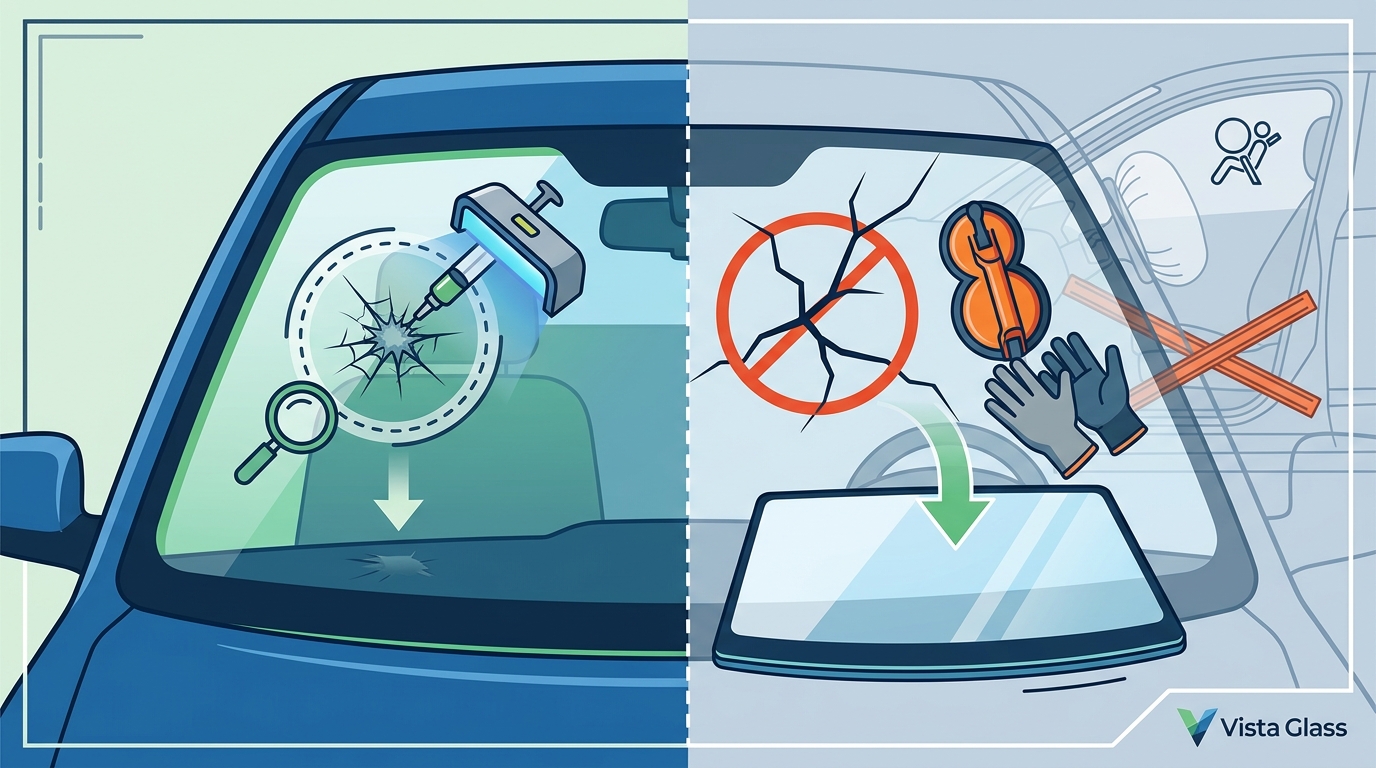
Repair may work when the damage is outside the critical viewing area
A repaired area can remain slightly visible even when the resin bonds successfully. If damage is directly in front of the driver, glare or optical distortion may remain distracting. A technician should decide whether a repair can preserve safe visibility or whether replacement is the more responsible choice.
Repair may be possible when only the outer layer is affected
The outer surface of laminated glass can sometimes be stabilized with resin. If the inner layer or plastic interlayer is compromised, the repair may not provide the required result. A technician may use lighting, inspection tools, and the damage pattern to evaluate depth.
For professional evaluation of a chip or small crack in Tucson, see Vista Glass’s Windshield Repair service.
When windshield replacement is usually necessary
Replacement removes the damaged windshield and installs new laminated glass designed for the vehicle. It is generally the safer path when the original glass can no longer provide reliable visibility, retention, or structural performance.
1. The crack is long, branching, or still spreading
Long cracks and complex networks of breaks are difficult to stabilize with resin. As a practical guideline, a crack longer than approximately three inches is frequently considered a replacement candidate, although the final decision depends on its location and pattern. A crack that continues to grow should be assessed promptly.
2. Damage is in the driver’s primary line of sight
Even a small impact point can reflect light, create glare, or distort objects ahead. This can become especially noticeable during nighttime driving, sunrise, sunset, rain, or when facing oncoming headlights. If a repair would leave a distracting optical defect, replacement may be recommended.
3. The damage reaches the windshield edge
Damage at or extending to the edge can weaken the area where the glass is bonded to the vehicle body. Edge cracks are also more likely to spread because the perimeter experiences stress from the frame, body flex, and temperature changes. Do not postpone an assessment when a crack touches the edge.
4. The glass is deeply damaged
If the impact has penetrated through the laminated construction or visibly damaged the inner surface, resin repair may not restore the windshield’s intended performance. Replacement is typically considered when the interlayer or both glass surfaces are affected.
5. You see delamination, bubbles, or persistent haze
Cloudiness or bubbles between the glass layers indicate that the laminate bond may be failing. Because this condition is within the windshield assembly rather than a simple surface chip, it generally cannot be corrected with ordinary chip repair.
6. A camera, rain sensor, or advanced driver-assistance feature is involved
Many newer vehicles use windshield-mounted cameras or sensors for features such as lane-keeping assistance, automatic emergency braking, rain-sensing wipers, or adaptive lighting. After replacement, the system may require inspection or recalibration according to the vehicle manufacturer’s procedures. Tell the glass provider about these features before scheduling service.
Vista Glass provides vehicle glass solutions through its Windshield Replacement service. A professional can verify the correct glass, molding, sensors, and installation requirements for your vehicle.
What to do after discovering a chip or crack
- Arrange an assessment soon. Small damage can worsen with Tucson heat, overnight temperature changes, road vibration, car-body flex, or additional debris.
- Keep the area clean and dry. Avoid applying household cleaners, adhesives, or tape directly over the damage. If temporary protection is needed, follow a technician’s instructions so contaminants do not become embedded.
- Avoid sudden temperature shock. Do not pour hot water on a cold windshield or aim extremely hot or cold air directly at the damaged area.
- Drive only when visibility and safety allow. If the crack obstructs your view, is rapidly spreading, or the glass is loose or severely shattered, arrange mobile service or towing rather than taking unnecessary risks.
- Ask about insurance before authorizing work. Coverage, deductibles, glass endorsements, and claim procedures vary by policy. Some policies cover eligible repairs with no deductible, while replacement may be subject to a deductible. Confirm the details with your insurer.
- Confirm post-installation requirements. Ask when the vehicle can be driven, whether the adhesive needs a minimum cure time, and whether camera or sensor calibration is required.
Windshield installation is not merely a cosmetic repair. NHTSA’s standards address windshield retention and glazing performance, and agency materials note that windshield bonding can affect how a passenger airbag is supported during deployment. ([nhtsa.gov](https://www.nhtsa.gov/interpretations/10354?utm_source=openai)) Choose a provider that treats fit, bonding, visibility, and vehicle-specific safety systems as part of the job.
Windshield repair versus replacement
| Consideration | Windshield repair | Windshield replacement |
|---|---|---|
| Best suited to | Small chips, bullseyes, star breaks, and limited outer-layer damage | Long cracks, edge damage, deep fractures, delamination, or severe visibility problems |
| Typical process | Clean the break, remove air and moisture, inject resin, and cure the repair | Remove damaged glass, prepare the bonding surface, install vehicle-specific glass, and allow adhesive cure time |
| Time | Often about 30–60 minutes, depending on complexity and conditions | Often about 1–2 hours for the installation, plus any required adhesive cure or calibration time |
| Cost | Usually lower than replacement when eligible | Usually higher because it includes new glass, labor, materials, and possibly calibration |
| Appearance | The impact may remain faintly visible after a successful repair | Provides a new glass surface, assuming correct fit and installation |
| Insurance | May be covered with a $0 deductible under some policies | May be covered but can involve a comprehensive-glass deductible |
These time, cost, and coverage ranges are general estimates rather than guarantees. Vehicle design, glass type, sensor equipment, weather, adhesive requirements, and insurance terms can change the final recommendation.
Key takeaways
- Small does not always mean repairable: location, depth, pattern, and visibility are just as important as size.
- Act quickly: a clean chip is generally easier to evaluate than one filled with dirt, water, or temporary chemicals.
- Edge cracks deserve priority: damage connected to the perimeter can compromise the bonded area and spread quickly.
- Driver visibility comes first: a repair that leaves glare or distortion in the primary viewing zone may not be the safest solution.
- Modern vehicles may need calibration: replacement can involve camera or sensor procedures in addition to the glass installation.
- Insurance is policy-specific: verify deductibles and claim requirements before service.
- Professional assessment is the deciding step: Vista Glass offers mobile auto-glass service in the Tucson area and can help determine whether repair or replacement is appropriate.
Frequently asked questions
How can I tell whether a windshield chip can be repaired?
A chip is more likely to be repairable when it is small, has not spread, is primarily in the outer layer, and is away from the driver’s critical viewing area and windshield edge. A technician should inspect it before confirming the service.
Does a crack always require windshield replacement?
No. Some short, uncomplicated cracks may be repairable, depending on their location, depth, age, and pattern. Long, branching, edge-connected, deep, or vision-obstructing cracks commonly require replacement.
How long does windshield repair take?
Many chip repairs take approximately 30 to 60 minutes. Actual time varies with the damage, weather, curing conditions, vehicle access, and the technician’s inspection. Ask when it is safe to wash or drive the vehicle after service.
How long does windshield replacement take?
The glass installation itself often takes about one to two hours, but the vehicle may need additional time for adhesive curing, trim installation, quality checks, or advanced-driver-assistance-system calibration.
Can I drive with a cracked windshield?
Driving with damage may be unsafe, particularly when the crack blocks your view, reaches the edge, is growing, or affects the glass’s stability. If visibility is compromised or the windshield is severely damaged, ask about mobile service or towing instead of driving unnecessarily.
Will insurance pay for windshield repair or replacement?
Coverage depends on your policy and state-specific terms. Some comprehensive policies cover qualifying repairs with no deductible, while replacement may involve a deductible. Contact your insurance carrier to confirm coverage, claim rules, and approved-provider requirements.
Is a windshield with bubbles or haze repairable?
Bubbles, cloudy areas, or moisture between the laminated layers may indicate delamination. Because the problem affects the windshield assembly, replacement is generally the appropriate solution rather than ordinary chip repair.
What happens if my vehicle has a camera behind the windshield?
The camera or sensor may need to be inspected and recalibrated after replacement. Tell the auto-glass provider about lane-assistance, automatic braking, rain-sensing, or other windshield-mounted technology before work begins.
Can Vista Glass come to my location in Tucson?
Vista Glass offers mobile glass service in the Tucson area, subject to vehicle access, damage conditions, weather, and scheduling. Call 520-744-7766 to discuss your vehicle and location.
Get a professional windshield assessment from Vista Glass
If you are unsure whether the damage needs resin repair or a complete replacement, do not guess based only on the crack’s length. Vista Glass serves Tucson and the surrounding area with auto-glass repair and replacement, mobile service, transparent estimates, insurance-friendly assistance, and emergency availability. The team can evaluate the damage and explain the safest practical option for your vehicle.
For broader vehicle glass needs, visit Vista Glass’s Glass Replacement page. To learn more about the company’s approach and services, see About Us. To request an estimate or arrange service, visit the Contact Us page or call 520-744-7766.