

Tucson experiences some of the most extreme thermal fluctuations in the United States, with summer temperatures regularly exceeding 110 degrees Fahrenheit. This intense heat creates unique stressors on automotive glass, causing rapid expansion and contraction that can turn minor chips into catastrophic cracks. According to the National Weather Service, the Phoenix-Mesa-Scottsdale metropolitan area, which includes Tucson, holds the record for the most days per year with temperatures above 100 degrees. This environmental reality makes professional windshield chip repair not just a convenience, but a critical safety requirement for vehicle owners in the region. (About Vista Glass)
Why Tucson's Heat Accelerates Glass Damage
Windshield glass is primarily composed of silica, which expands when heated and contracts when cooled. In Tucson, where daily temperature swings can exceed 40 degrees between day and night, this cycle places immense stress on the laminated layers of the windshield. A small chip, which might remain stable in a temperate climate, can rapidly propagate into a long crack under thermal stress.
The primary cause of this propagation is the differential expansion between the glass and the surrounding frame or rubber seals. When the glass expands faster than the adhesive holding it in place, micro-fractures form. These fractures act as stress concentrators, allowing cracks to spread with minimal additional impact. This phenomenon is particularly dangerous because it compromises the structural integrity of the windshield, which serves as a critical component in the vehicle's rollover protection system.
Furthermore, the intense UV radiation in Southern Arizona degrades the polymer interlayer of the windshield over time. This degradation reduces the adhesive bond strength, making the glass more susceptible to separation from the frame during thermal expansion. Understanding these physical principles is essential for recognizing why immediate repair is necessary in this specific geographic region.
Essential Standards for Professional Repair
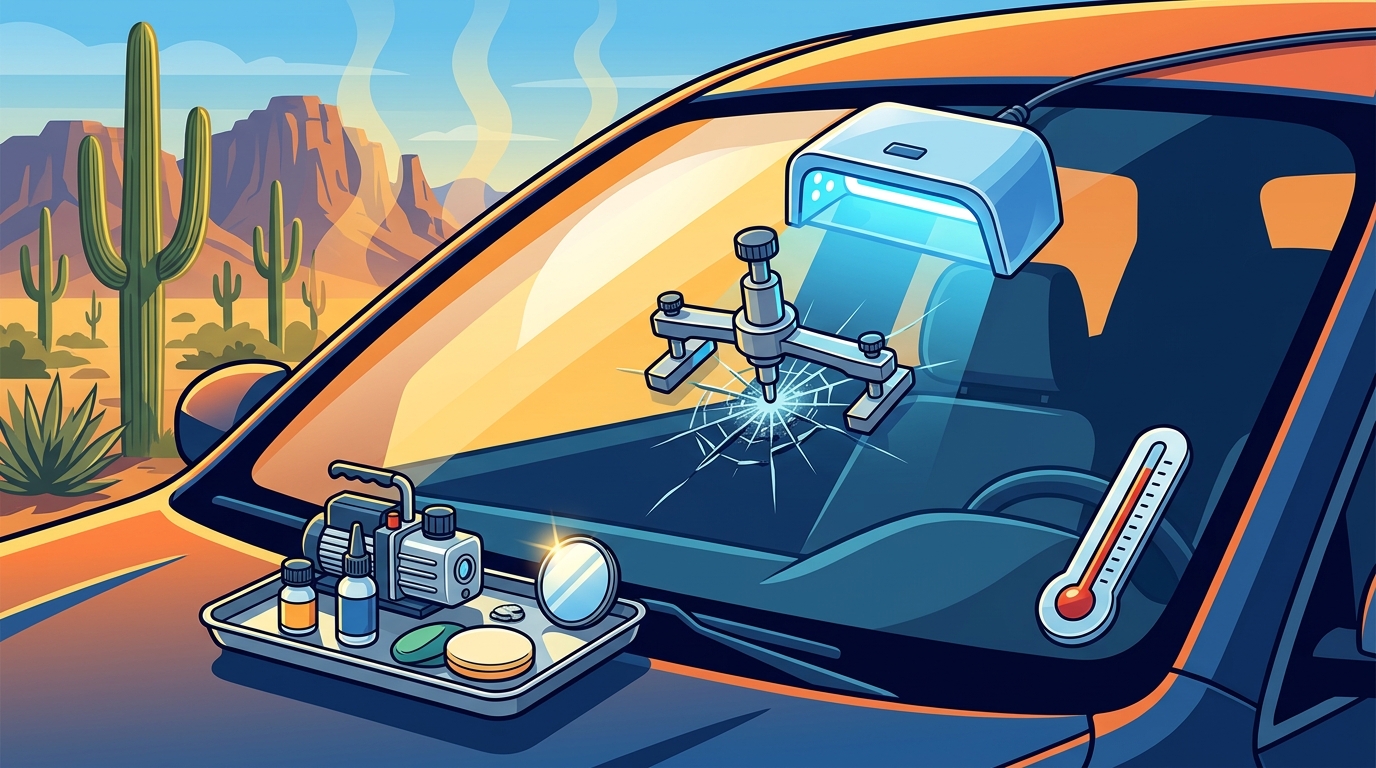
Professional windshield chip repair in Tucson must adhere to strict technical standards to ensure longevity and safety. The first standard involves the use of high-viscosity, UV-stable resin. Standard resins used in cooler climates may fail to cure properly or may degrade quickly under Tucson's intense solar radiation. High-quality resins are formulated to withstand temperatures exceeding 150 degrees Fahrenheit without yellowing or losing adhesion.
The second standard is the application of vacuum pressure. A professional repair technician must use a specialized bridge tool to create a vacuum around the chip. This process removes air and moisture from the fracture, allowing the resin to penetrate deep into the glass layers. Without this step, air bubbles remain trapped, reducing visibility and creating new stress points that can lead to future cracking.
The third standard is precise temperature control during the curing process. The resin must be cured using ultraviolet light at a controlled rate. If the curing is too rapid, the resin may shrink, creating a visible blemish. If it is too slow, the resin may not fully bond with the glass. Professional technicians in Tucson often perform repairs in climate-controlled environments or during cooler parts of the day to ensure optimal curing conditions.
Finally, the repair must meet optical clarity standards. The goal is to restore visibility to near-original levels. A poorly executed repair can cause light refraction, leading to glare during Tucson's bright daylight hours or at night. This glare can significantly impair driver vision, increasing the risk of accidents. Therefore, the aesthetic outcome is just as important as the structural repair.
The Risks of DIY Repair in Extreme Climates
While do-it-yourself repair kits are widely available, they pose significant risks in Tucson's climate. These kits typically use lower-grade resins that are not designed to withstand extreme thermal cycling. When exposed to the high temperatures common in Southern Arizona, these resins can become too fluid, leaking out of the chip and creating a messy, ineffective repair.
Another major risk is the inability to remove air from the fracture. DIY kits rely on capillary action to draw resin into the chip, which is often insufficient for deeper or wider damage. In contrast, professional tools use vacuum pressure to ensure complete penetration. Without this pressure, air pockets remain, which can expand in the heat and cause the crack to spread further.
Additionally, improper curing is a common issue with DIY repairs. Without controlled UV light sources, users often rely on sunlight, which can be inconsistent and too intense. This can lead to uneven curing, where the resin hardens on the surface but remains soft underneath. This partial cure leaves the repair vulnerable to failure under thermal stress.
Finally, DIY repairs often lack the precision required for optimal optical clarity. The result is frequently a visible blemish that distracts the driver. In a region where driving conditions can be challenging due to heat haze and bright sunlight, any reduction in visibility is a safety hazard. Professional repair ensures that the windshield is restored to a safe and clear state.
Professional Repair vs. Full Replacement
Deciding between repair and replacement depends on the size, depth, and location of the damage. Generally, chips smaller than one inch in diameter can be repaired effectively. However, cracks longer than three inches or those that extend into the driver's line of sight often require full replacement.
| Factor | Professional Chip Repair | Full Windshield Replacement |
|---|---|---|
| Cost | Affordable and often covered by insurance | Higher cost, may involve deductible |
| Time | 30 to 60 minutes | 1 to 2 hours including curing time |
| Structural Integrity | Restored for minor damage | Complete restoration of safety standards |
| Heat Resistance | Requires high-grade UV-stable resin | New adhesive ensures optimal bond |
| Optical Clarity | Near-original visibility | Perfect visibility |
Professional repair is the preferred option when possible because it preserves the original factory seal of the windshield. This seal is critical for preventing water leaks and maintaining the structural rigidity of the vehicle. Full replacement should be reserved for damage that cannot be safely or effectively repaired.
Key Takeaways
- Tucson's extreme heat causes rapid thermal expansion, accelerating the spread of windshield chips.
- Professional repair requires high-viscosity, UV-stable resin to withstand temperatures over 110 degrees Fahrenheit.
- Vacuum pressure is essential for removing air and ensuring deep resin penetration into the glass layers.
- DIM repair kits often fail in extreme climates due to improper curing and inadequate resin quality.
- Chips smaller than one inch are typically repairable, while cracks over three inches require replacement.
- Professional repair preserves the original factory seal, maintaining the vehicle's structural integrity.
- Vista Glass employs certified technicians who adhere to strict safety and quality standards.
Frequently Asked Questions
Can I repair a windshield chip in Tucson during the summer?
Yes, but it is best to schedule the repair during cooler parts of the day or in a climate-controlled environment. Extreme heat can affect the curing process of the resin, potentially leading to suboptimal results.
How long does a professional windshield chip repair take?
A standard chip repair typically takes between 30 to 60 minutes. This includes the time for inspection, resin application, vacuum pressure treatment, and UV curing.
Will a repaired chip disappear completely?
The repair will significantly reduce the visibility of the chip, but it may not disappear entirely. The goal is to restore structural integrity and optical clarity, not to make the damage invisible.
Does Vista Glass offer mobile windshield repair services?
Yes, Vista Glass provides mobile windshield repair and replacement services throughout Tucson and surrounding areas. This convenience ensures you can get your vehicle fixed without leaving your home or office.
What size chip can be repaired?
Generally, chips smaller than one inch in diameter can be successfully repaired. Cracks longer than three inches or those that reach the edge of the windshield usually require full replacement.
Is windshield repair covered by insurance?
Many insurance policies cover windshield repair with no deductible, especially in states with comprehensive glass coverage. It is advisable to check with your provider before scheduling service.
Why is professional repair better than DIY in hot climates?
Professional repair uses specialized tools and high-grade resins designed to withstand extreme heat. DIY kits often fail in these conditions due to improper curing and inadequate resin quality.
How does heat affect windshield adhesive?
Heat can degrade the adhesive bond over time, making the windshield more susceptible to separation. Professional replacement ensures the use of high-quality, heat-resistant adhesive for a secure fit.
Schedule Your Service
Do not let Tucson's extreme heat compromise your vehicle's safety. If you have a chip or crack in your windshield, contact Vista Glass today for professional repair services. Our certified technicians use advanced techniques and high-quality materials to ensure your windshield is restored to optimal condition. Call us at 520-744-7766 or visit our contact page to schedule an appointment. We serve Tucson, Pima County, and Cochise County with reliable and affordable glass solutions.